Birkenstock’s figurative mark for shoe soles not protectable

Attorney at Law | Certified
Intellectual Property Law Attorney
Decision of Federal Patent Court of 17.6.2022 – 29 W (pat) 10/19 / Decision of Federal Court of Justice of 23.2.2023 – I ZB 55/22
Birkenstock had registered the following sign
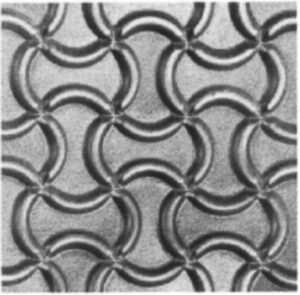
in black and white on 29 March 2012 for, inter alia, “footwear and parts and accessories of footwear, namely …. outsoles, insoles, shoe bottom parts…” as a figurative trade mark (Class 25) at the German Patent and Trade Mark Office (DPMA). The figurative mark was also initially entered in the trade mark register for these goods on 31 May 2012 under the number 30 2012 022 812.
In July 2015, applications for cancellation of the trade mark were filed by third parties. The applicants claimed, inter alia, that the registered figurative mark was devoid of “any distinctive character” within the meaning of Section 8 (2) No. 1 German Trade Mark Act. By decision of 19 December 2018, the Cancellation Division of the DPMA had rejected the cancellation requests, inter alia, for the aforementioned goods.
The appeals filed by the applicants against this decision of the DPMA were largely successful and led to the cancellation of the figurative trade mark for, inter alia, the aforementioned goods.
Decision of the 29th Senate of the Federal Patent Court
The 29th Senate denied the distinctive character of the figurative mark, in particular for shoes and their soles, stating inter alia the following:
In particular with regard to the aforementioned goods in class 25, the figurative mark is limited to the representation of a usual decorative, ornamental pattern which is not understood by the target public as an indication of commercial origin. Even if one were to assume – as the Cancellation Division did – that the figurative sign was a spatially limited, self-contained figurative mark, one could recognise in the representation a pattern which could be applied to the surface of the goods in a large area next to each other or applied decoratively or as an appliqué as a single square. Although the criteria for assessing distinctiveness are the same for all categories of trade marks, it must be borne in mind that the relevant public’s perception is not the same for each category of trade mark. This is particularly true where the sign in question is consistent with the external appearance.
The Senate also pointed out that a sign applied for or registered as a figurative mark cannot be classified as a mere figurative design solely on the ground that it would appear to be a design if it were repeated indefinitely. However, the Court held that the sign at issue was itself composed of a repetitive sequence of elements, so that it was likely to be used only as a surface design. Therefore, the sign would be perceived by the relevant public only as a decorative element and not as a product identifier.
In that regard, it is sufficient for use as a surface design to be ‘possible and not unlikely’. In particular, as regards the footwear in question and its soles, the design reproduced in the contested figurative mark would be suitable for decoration. Those goods could either be decorated with such a design over a large area or show the design as an application in certain places. In those circumstances, the relevant public would immediately and without further reflection perceive the sign as a representation of the goods in question, that is to say, as a descriptive indication, and not as an indication of their commercial origin. Even if the figurative sign could not be described, in a rather pejorative sense, as ‘banal’, it does not have such a special character that the public would perceive it as an indication of origin and not as a – possibly interesting – design.
With its decision, the German Federal Patent Court followed the opinion of the European Court of Justice (ECJ) in its judgment of 13 September 2018, Case C-26/17, which had to decide on the protectability of the EU part of Birkenstock’s international registration No. 1132742
The basic trade mark of this international registration is the above-mentioned German trade mark no. 30 2012 022 812. The ECJ held – like the previous instances (see the decision of the First Board of Appeal at the EUIPO of 15 May 2014, R 1952/2013-1 and the judgment of the European Court of First Instance of 9 November 2016, ref. November 2016, Case T-579/14), that signs consisting of a repetitive sequence of elements are likely to be used as a surface design and thus “merge” with the appearance of the goods. In the case of such signs, consumers would not normally infer the commercial origin of the goods. Such a sign would only have distinctive character if it deviated significantly from the norm or custom in the sector. That is not the case here.
The Federal Patent Court did not allow an appeal against its decision to the Federal Court of Justice (BGH). In the context of the so-called “inadmissible appeal”, Birkenstock had complained about the violation of the right to be heard. By decision of 23 February 2023, the BGH dismissed the appeal as unfounded. It noted that the Federal Patent Court had taken note of and considered Birkenstock’s submissions. However, the fact that the Federal Patent Court ultimately reached a different legal conclusion did not violate Birkenstock’s right to be heard.
Comment
This case shows that it is not easy to register a figurative sign which has the appearance of a design and for which there is at least a likelihood that this design is identical to the goods to be protected or to parts of those goods, or – to use the words of the ECJ – that it is ‘merged’ with those goods.
A similar “fate” to Birkenstock’s figurative sign had also the EU trade mark application No. 018206086 of Mercedes Benz Group’s filed on 6 March 2020:
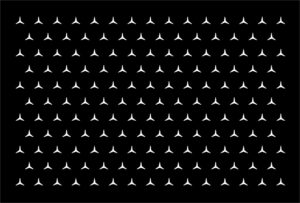
The application was rejected by the EUIPO for lack of distinctiveness. As in the Birkenstock case, the applicant’s appeal against the EUIPO decision was unsuccessful. In this case, too, the Fifth Board of Appeal found that the mark applied for had merged with the appearance of the goods it was intended to designate. As the mark did not depart significantly from the norm or custom of the sector, it lacked the inherent distinctiveness required for protection. This decision was upheld by the European Court in its judgment of 30 March 2002, case no. T-278/21.
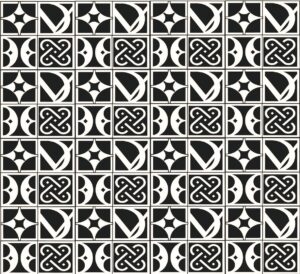
In order to avoid the refusal of a trade mark application consisting of a design, either a complex design should be chosen which is clearly different from the usual design in the industry, as for example the following registered EU trade mark No. 018681485 shows:
Alternatively, a figurative/design mark can be protected if it contains a distinctive word element, such as a name, as illustrated by the EU registered trade mark No. 018745323 ‘GHERARDINI’ shown below:
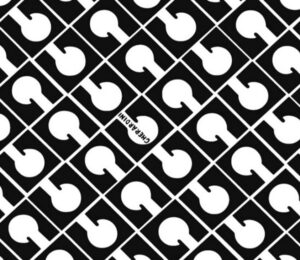
The two EU registered trade marks shown above are protected for, among other goods, footwear and shoe soles.